Rules of Composition have been used for thousands of years to make art that leaves an impression.
The intentional arranging of elements within a frame wasn’t always called “Rules of Composition”, but the practice has remained largely unchanged over all these years.
When photography was first invented in the 1800s, these composition principles began to be applied by photographers as well.
To this day, photographers still apply these principles every time they compose a photo.
Even with fancy, modern cameras the need for Rules of Composition has not disappeared — a testament to the impact these principles have on all art forms.
Out of 25 rules, these are the 3 best
There are well over 25 rules recognized by photographers, but today I’m going to focus on three that have had the biggest impact on my photography. Here’s how you can apply them to your photos:
1. Rule of Thirds
The Rule of Thirds is so popular, many non-photographers have even heard of it. This is when elements in a frame line up along the 1/3 and 2/3 vertical or horizontal lines to create a more harmonious composition.
It’s also the placement of key points in the intersecting points of those lines that helps create a stronger, more captivating photo.
The Rule of Thirds works because placing key elements off-center aligns with how our eyes naturally scan a scene.
Generally, you shouldn’t place your horizon lines right across the center of the image or stick your subject smack dab in the middle of the frame. Following this rule helps us to avoid making that mistake.
|
|
|
|
2. Leading Lines
Leading lines is the use of visual lines that help guide the eye to easily find the main point of interest in the photo.
When the eye first sees a photo, it spends energy looking across the whole image, trying to make sense of the visual data. If there are a lot of different elements and distractions, it can be hard for the eye to quickly identify and register the main subject.
If making sense of a photo takes too much time or energy, the eye can get tired and want to move on to the next photo. Leading lines help to guide the eye so it doesn’t give up too quickly and lose interest.
|
|
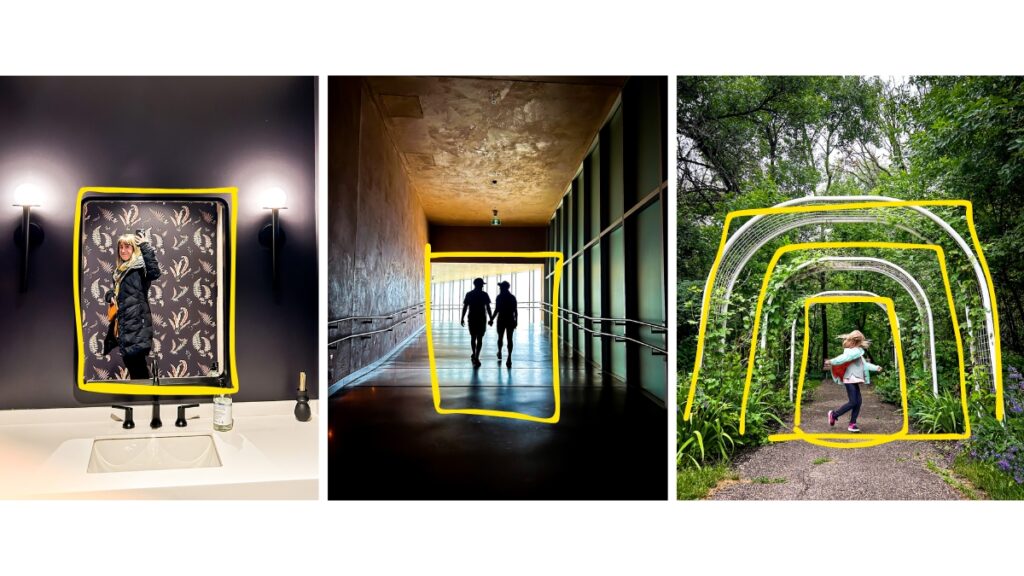
3. Frame Within A Frame
Similar to leading lines, a Frame Within A Frame is a rule that helps bring more attention and focus on the primary subject.
Sometimes a subject doesn’t need extra emphasis, but a frame around your subject can help make the story in your photo even more captivating.
To apply this rule, simply place your subject within a natural frame inside your photo.
This can be a literal frame around your subject (like a selfie in a mirror), a window of light framing your subject from behind or arches surrounding your subject.
|
|
|
|
There are well over 25 Rules of Composition in photography, and these three are just the beginning! But if you apply these as a start, you’ll probably see some noticeable improvements in your photos.